Brazil's Food Sector SMEs Chart a Course Through Industry 4.0 — Before the Window Closes
Brazilian food SMEs are racing to adopt Industry 4.0. Here's why a structured digital roadmap isn't optional anymore.
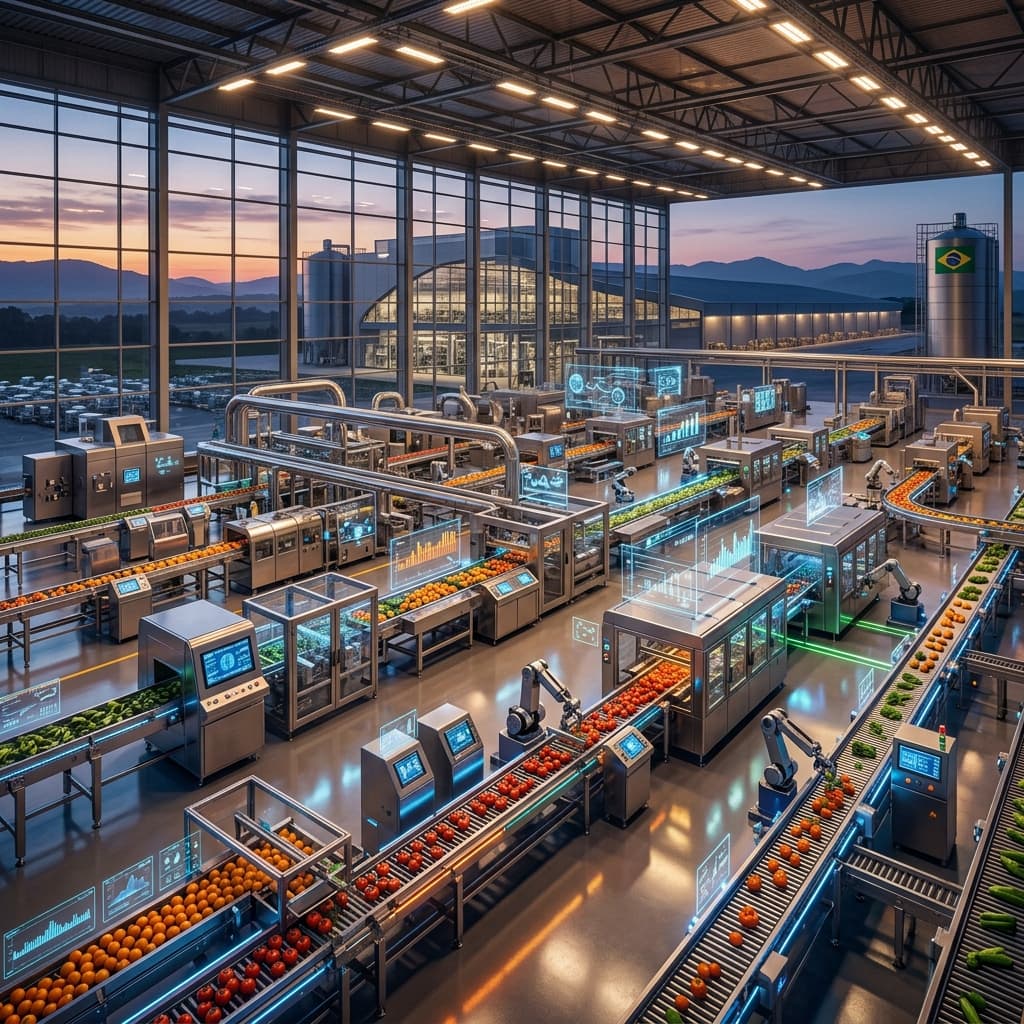
The Quiet Urgency Behind a Plate of Food
Brazil produces enough food to feed more than a billion people. Its agribusiness sector accounts for roughly 25% of GDP, and within that vast machine, thousands of small and mid-sized food processing companies form the connective tissue — the family-owned meat processors in Rio Grande do Sul, the specialty grain millers in Mato Grosso, the artisanal dairy cooperatives in Minas Gerais. These companies are the backbone of Brazilian food security and export competitiveness.
And most of them are dangerously behind on digital transformation.
This is not a criticism. It is a structural reality. The tools of Industry 4.0 — IoT sensors, AI-driven predictive maintenance, automated quality control, supply chain intelligence — were designed at scale, priced for large enterprises, and marketed in English. For a food SME operating on tight margins in Ribeirão Preto or Caxias do Sul, the entry point was never obvious.
But the window for a gradual, comfortable transition is closing faster than most CEOs realize.
What Industry 4.0 Actually Means for a Food Company
Strip away the buzzwords, and Industry 4.0 in the food sector comes down to three operational imperatives: real-time visibility, predictive intelligence, and process automation.
Real-time visibility means knowing — at any given moment — what is happening on the production floor, in the cold chain, and across your supplier network. Not tomorrow's report. Now. IoT-connected temperature sensors, RFID inventory tracking, and digital production dashboards are no longer luxury infrastructure. They are the baseline for regulatory compliance in markets like the European Union, the United States, and increasingly Brazil's own MAPA (Ministry of Agriculture) digital traceability requirements.
Predictive intelligence means using historical and real-time data to anticipate equipment failures before they become shutdowns, forecast demand shifts before they become waste, and detect quality deviations before they become recalls. A single product recall in the food industry can cost a company years of reputation. AI-driven quality inspection systems — now accessible via cloud-based SaaS models — are changing that risk calculus entirely.
Process automation means reducing dependency on manual, error-prone steps in packaging, labeling, documentation, and logistics coordination. When Microsoft deploys agentic AI solutions for retail and supply chains, the downstream pressure on food suppliers to integrate compatible digital infrastructure is immediate and non-negotiable.
The Roadmap That Makes Adoption Possible
At FM Solutions, we've worked with food sector clients who came to us convinced they needed to "digitize everything at once." That instinct, while understandable, is one of the primary reasons digital transformation projects fail.
The structured roadmap approach — phased, modular, ROI-anchored — is what actually works for SMEs. Here is the architecture we recommend:
Phase 1: Digital Diagnostic and Data Foundation
Before any technology is deployed, a rigorous operational audit must establish where data currently lives, how decisions are actually made, and where the highest-cost inefficiencies sit. In most food SMEs, this phase reveals that 60–70% of operational data is either siloed in spreadsheets or simply not being captured at all. That is the starting point.
Phase 2: Connectivity and Sensor Infrastructure
Selective IoT deployment — not a full factory overhaul — targeting the three or four critical control points in production that, if monitored in real time, would prevent the largest sources of loss. For a cold-chain dairy operation, this might mean temperature and humidity monitoring across refrigeration units and transport vehicles. The investment is measured in thousands, not millions.
Phase 3: Intelligence Layer and AI Integration
Once clean data flows exist, AI becomes genuinely useful rather than theoretically attractive. Predictive maintenance models, demand forecasting algorithms, and computer vision quality checks can be layered in progressively. As executives from Amazon and Google emphasized at the BTG Summit 2026, AI adoption is no longer a competitive advantage — it is a survival requirement. Food companies exporting to Europe or the US will face increasing pressure from buyers demanding digital traceability documentation as a condition of purchase.
Phase 4: Integration, Compliance, and Scale
The final phase connects internal systems with external platforms: ERP integration, regulatory reporting automation, supplier portal connectivity, and export compliance documentation. This is where the investment pays compounding dividends.
The Cost of Waiting
The risk of inaction is asymmetric. A food SME that waits two more years to begin this journey will not simply be "two years behind." It will be operating under conditions that the market, regulators, and major buyers will have fundamentally restructured around digital-first requirements.
Brazilian food companies have an extraordinary window of comparative advantage right now — in terms of raw material competitiveness, geographic positioning, and production scale. But those natural advantages erode rapidly when operational inefficiency, quality inconsistency, and lack of traceability undermine the trust of international buyers.
Industry 4.0 is not a technology project. It is a business survival strategy. And the time to build the roadmap is not when the pressure becomes unbearable — it is now, while there is still room to move deliberately and intelligently.
The plate of food that reaches a consumer in Berlin, Milan, or Miami carries with it a chain of decisions. The companies that control that chain — digitally, intelligently, in real time — are the ones that will still be at the table in a decade.

AI as an operating model decision, not a software decision
BCG shows that AI-first companies are redesigning processes from scratch — and that changes what adopting AI means for an SMB.

AI Beyond the Hype: Companies Now Demand ROI Before Investing
The AI euphoria cycle is over. Corporations and SMEs now require measurable returns before any new technology investment.

OpenAI and McGraw-Hill launch AI agents for corporate training
OpenAI and McGraw-Hill integrate autonomous agents into training platforms and cut training time by 40%. What this means for Brazilian SMEs.