China Produces 10,000 Humanoid Robots Per Year — and That Changes Everything
A fully automated line in Guangdong already manufactures 10,000 humanoid robots per year. What does this mean for manufacturing SMEs?
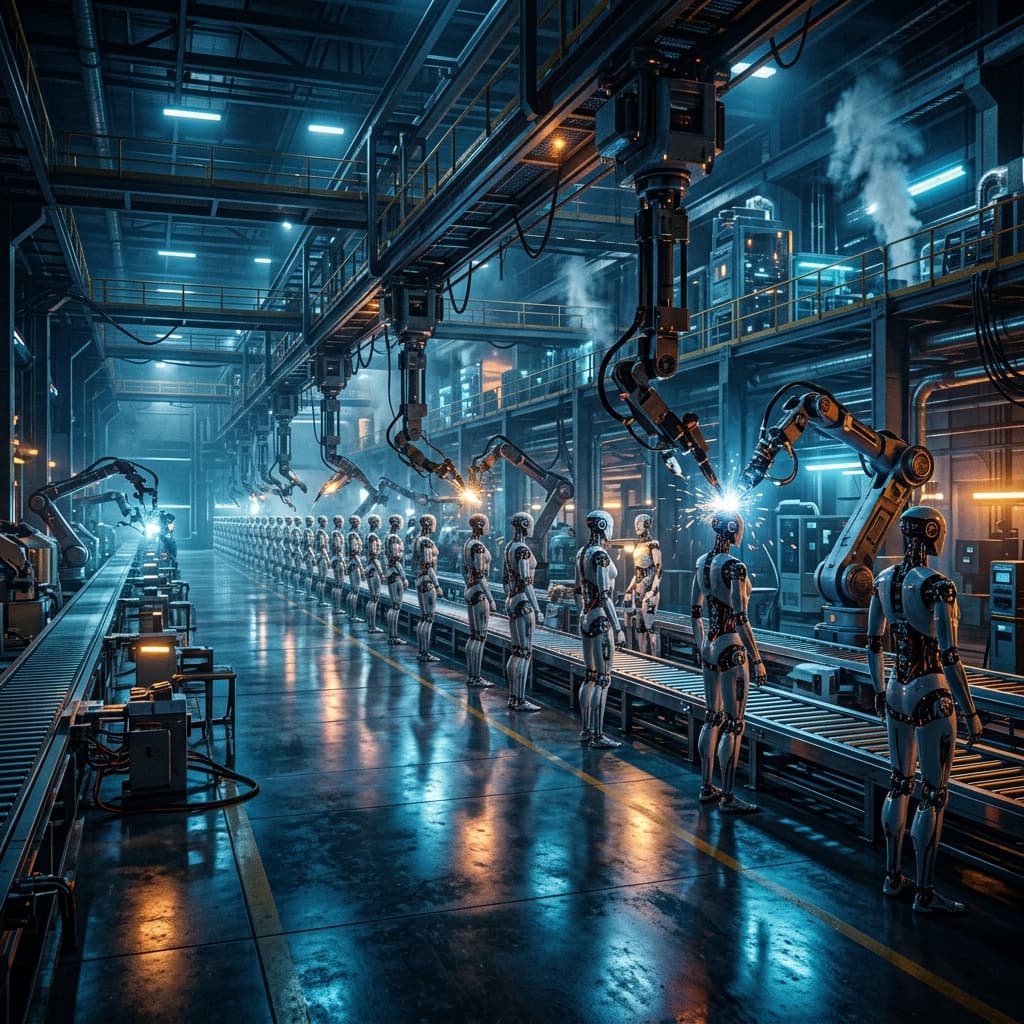
In March 2026, a factory in Guangdong, China, crossed a threshold the robotics industry had been trying to reach for years: industrial-scale production of humanoid robots at full volume. We are not talking about laboratory prototypes or controlled pilots — the line runs at a pace of 10,000 units per year, with end-to-end automation in the manufacturing process itself. This is a turning point, and anyone working in manufacturing, logistics, or supply chain needs to understand what it means.
From the Test Bench to the Factory Floor
The transition from experimental robotics to mass production rarely happens gradually. It occurs in leaps — when a set of conditions (component costs, software maturity, manufacturing infrastructure) reaches a point of equilibrium simultaneously. That is what happened with solar panels between 2010 and 2015, and with lithium batteries between 2017 and 2022. In both cases, the cost drop was faster than any market projection had anticipated.
With humanoid robots, we are at the beginning of that same cycle. The Guangdong factory is not merely an engineering achievement — it is a structural signal that the learning curve has already begun to compress costs irreversibly.
What Makes This Moment Different
Humanoid robots have a specific operational advantage over traditional industrial robots: they are designed to operate in environments built for humans. This means they do not require layout reconfiguration, dedicated cell installation, or conveyor adaptation. A standard warehouse, a conventional assembly line, an unmodified picking area — the humanoid robot walks in and operates.
Compared to fixed automation systems such as FANUC robotic arms or Universal Robots collaborative cells, the humanoid offers task flexibility that rigid systems simply do not have. Product changeovers, line repositioning, adaptation to flow variations — tasks that in conventional automation require physical reprogramming and reconfiguration — become far simpler.
Price remains a real barrier: state-of-the-art humanoid units such as the Unitree H1 or the Figure 02 range from US$ 16,000 to US$ 150,000 depending on specification and supplier. But Guangdong's scale points directly toward a reduction in those figures. Historically, when a product moves from artisanal production to an industrial line of 10,000 units per year, the unit cost falls between 40% and 60% within 24 to 36 months.
What Changes for Manufacturing and Logistics SMEs
Here is the point that interests me most as a consultant working with small and medium-sized businesses in Brazil, Italy, and the United States: the physical automation of picking and assembly tasks is about to stop being the exclusive domain of large corporations.
Today, an SME that wants to automate a picking cell faces two paths: (1) invest in fixed systems costing between R$ 500,000 and R$ 2 million that require a dedicated layout, or (2) continue relying on labor for repetitive, low-value tasks. There is no viable middle ground.
With humanoid robots at industrial scale, a third path emerges: general-purpose equipment with declining acquisition costs, capable of being relocated between tasks. The economic model resembles an IT asset more than an industrial plant — something that can be depreciated, updated via software, and repurposed as demand shifts.
Concrete Use Cases for Decision-Makers Today
There is no reason to wait until 2028 to start thinking about this scenario. Companies that today perform manual item picking in e-commerce warehouses, kitting operations in electronics component industries, or promotional kit assembly in consumer goods are natural candidates to pilot humanoids as soon as prices cross the viability threshold for SMEs — estimated by some analysts at around US$ 25,000 to US$ 30,000 per unit.
What I recommend to managers who reach out to me today: do not wait for the product to reach the ideal price before starting to prepare. The process of integrating humanoid robots requires operational flow review, team training for human-machine supervision, and adaptation of ERP and WMS systems to capture productivity data from these physical agents. Those who begin this mapping now will have the advantage when the technology becomes accessible.
What China Is Signaling to the World
This is not the first time China has used industrial scale to transform a niche technology into a commodity. The strategy is well known: invest in productive capacity before demand is fully consolidated, force prices down through volume, and dominate the global supply chain before Western competitors can react.
With humanoid robots, the pattern repeats — but at a speed that surprises even the most attentive observers. The Guangdong factory is simultaneously a technological milestone and a geopolitical move. For the Brazilian market, which still imports the majority of its automation equipment, this could be a rare window of opportunity: acquiring cutting-edge technology at declining prices, without having to wait decades for it to become accessible.
The question is no longer whether humanoid robots will reach the factory floors of SMEs. The question is whether managers will be ready when it happens.

Thinking Machines Lab launches Inkling: 975 billion open-weight parameters
Mira Murati's Thinking Machines Lab launches Inkling, an open-weight MoE model with 975 billion parameters. What changes for Brazilian companies?

Kimi K3: the largest open-weight model ever released has 2.8T parameters
Moonshot released Kimi K3: 2.8 trillion parameters and a 1-million-token context window. What actually changes, and what open-weight really delivers.
Meta Brain2Qwerty v2: when the mind becomes a keyboard with 61% accuracy
Meta decodes brain activity into text with 61% accuracy — no surgery required. What this changes for business, healthcare, and accessibility.