Gemini Now Controls Computers: What Changes for SMEs
Google DeepMind announces Gemini with computer control and chained task execution. Understand the real impact for businesses.
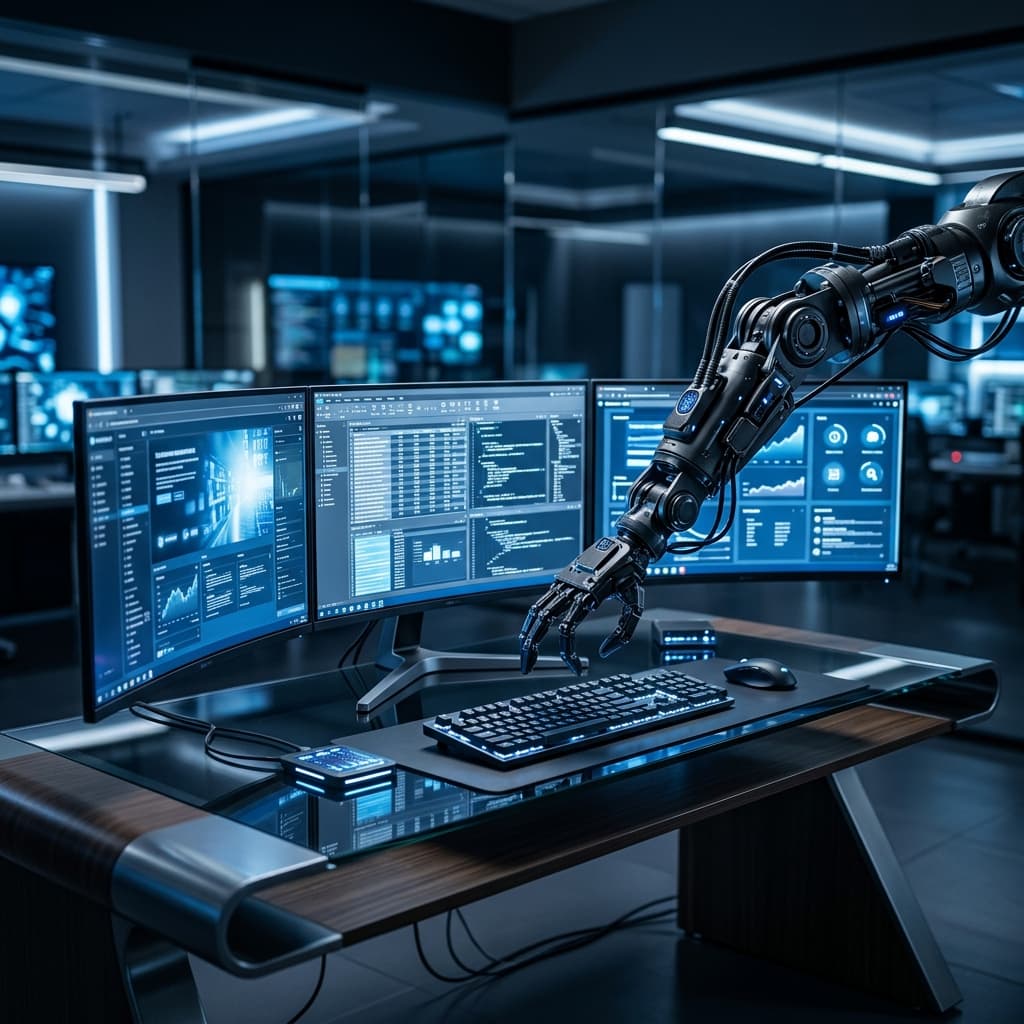
Google DeepMind has just crossed the boundary that separates the chatbot from the agent, the Gemini models can now control computer interfaces, navigate applications, fill forms, perform searches and chain multiple actions to complete complex tasks, all autonomously, without a human needing to click every step.
This is not a cosmetic update. It is a paradigm shift in what it means to "use AI" in a company’s day to day.
From Answers to Execution, What Gemini Is Doing Now
Until recently, language models like Gemini, GPT-4, or Claude essentially acted as text consultants, you asked and they answered. The intelligence was in the response, but execution still depended on a human or a custom technical integration.
What Google DeepMind is expanding now is different, Gemini can operate as a software operator. It observes the screen, understands the visual context of the interface, decides which actions to take and executes them in sequence. Meaning: open a browser, search for a supplier, copy data into a spreadsheet, send an email with the result, all in a single continuous flow triggered by a natural language instruction.
This capability has a technical name: computer use, or desktop control by AI agents. Anthropic was one of the first to demonstrate something similar with Claude in October 2024. Google is now accelerating its own version, integrating this behavior directly into the Gemini family, models that are already embedded in Google Workspace, Android and tools like NotebookLM.
How It Works in Practice
The model receives an objective in natural language, "research the top three packaging suppliers in the market and compile the prices in a document." From there it plans the steps, interacts with real applications (browser, spreadsheet, email) and delivers the result.
The process combines three capabilities: computer vision (to understand what is on the screen), planning reasoning (to decide the sequence of actions) and motor execution (to simulate clicks, typing and navigation). This is what the industry calls a long task multimodal agent, different from a simple agent that responds to a single prompt.
Why This Matters for SMEs in Brazil
I will be direct, for years I have been helping small and medium companies in Brazil, Italy and the US adopt automation. The biggest obstacle was never lack of interest, it was cost and technical complexity. Automating a back office process required a developer, an integration budget and weeks of mapping.
With agents that control computers, using interfaces that already exist, that obstacle drops dramatically. An SME no longer needs an exposed API from a legacy system to automate a task. If a human can do it by clicking the screen, the agent can too.
Three Concrete Use Cases for SMEs
1. Research and sales prospecting: A Gemini agent can search for potential customers on LinkedIn, industry sites and public registries, compile a qualified list with contacts and relevant data, and export directly to the CRM, without the salesperson spending hours on manual work.
2. Financial reconciliation: Opening the management system, the bank statement in PDF and the accounts payable spreadsheet, cross-checking the data and flagging discrepancies is exactly the kind of repetitive, high-volume task that drains finance teams at companies with 10 to 200 employees.
3. Post-sale support and follow-up: Checking order status in internal systems, drafting personalized response emails to customers and recording the interaction in the history, all without opening a ticket for IT.
These are not hypothetical cases. They are workflows I map with clients weekly. The difference is that, until now, automating these tasks required RPA (Robotic Process Automation) with tools like UiPath or Automation Anywhere, powerful solutions but with implementation curves and licensing costs many SMEs cannot absorb.
What Changes in Governance and Risk
Agents that execute autonomous tasks in real systems create a new risk vector. If the model misinterprets an instruction or encounters an unexpected state in the interface, it can perform a wrong action, delete a file, send an email to the wrong recipient, or submit a form with incorrect data.
This places AI governance at the center of the operational agenda, not just the IT agenda. Companies need to define:
- Which tasks the agent can execute without human review
- Which require approval before final execution
- How to audit the agent's action history
- Who is responsible when something goes wrong
In the Brazilian context, this gains an extra layer, the LGPD imposes obligations on the automated processing of personal data. An agent that accesses systems with customer and supplier data needs a clear policy on use and retention.
What to Do Now
The ability of agents to control computers is not mature enough to replace critical processes without human supervision, not yet. But it is mature enough for controlled pilots on medium risk, high volume tasks.
My recommendation for SME leaders: start with mapping. Identify the three tasks that consume the most repetitive time in your operation and assess which of them an agent could execute with supervision. Do not wait for the perfect product. Companies piloting now will have a considerable learning advantage when the technology scales.
Gemini controlling computers is not science fiction. It is the next step in a curve that has already begun, and those who redesign their workflows before the curve will reap the results after it.

Thinking Machines Lab launches Inkling: 975 billion open-weight parameters
Mira Murati's Thinking Machines Lab launches Inkling, an open-weight MoE model with 975 billion parameters. What changes for Brazilian companies?

Kimi K3: the largest open-weight model ever released has 2.8T parameters
Moonshot released Kimi K3: 2.8 trillion parameters and a 1-million-token context window. What actually changes, and what open-weight really delivers.
Meta Brain2Qwerty v2: when the mind becomes a keyboard with 61% accuracy
Meta decodes brain activity into text with 61% accuracy — no surgery required. What this changes for business, healthcare, and accessibility.