AI accelerates breast cancer radiotherapy planning at UCSD
Researchers at UC San Diego use deep learning to accelerate and improve radiotherapy planning for breast cancer. What this means for healthtech.
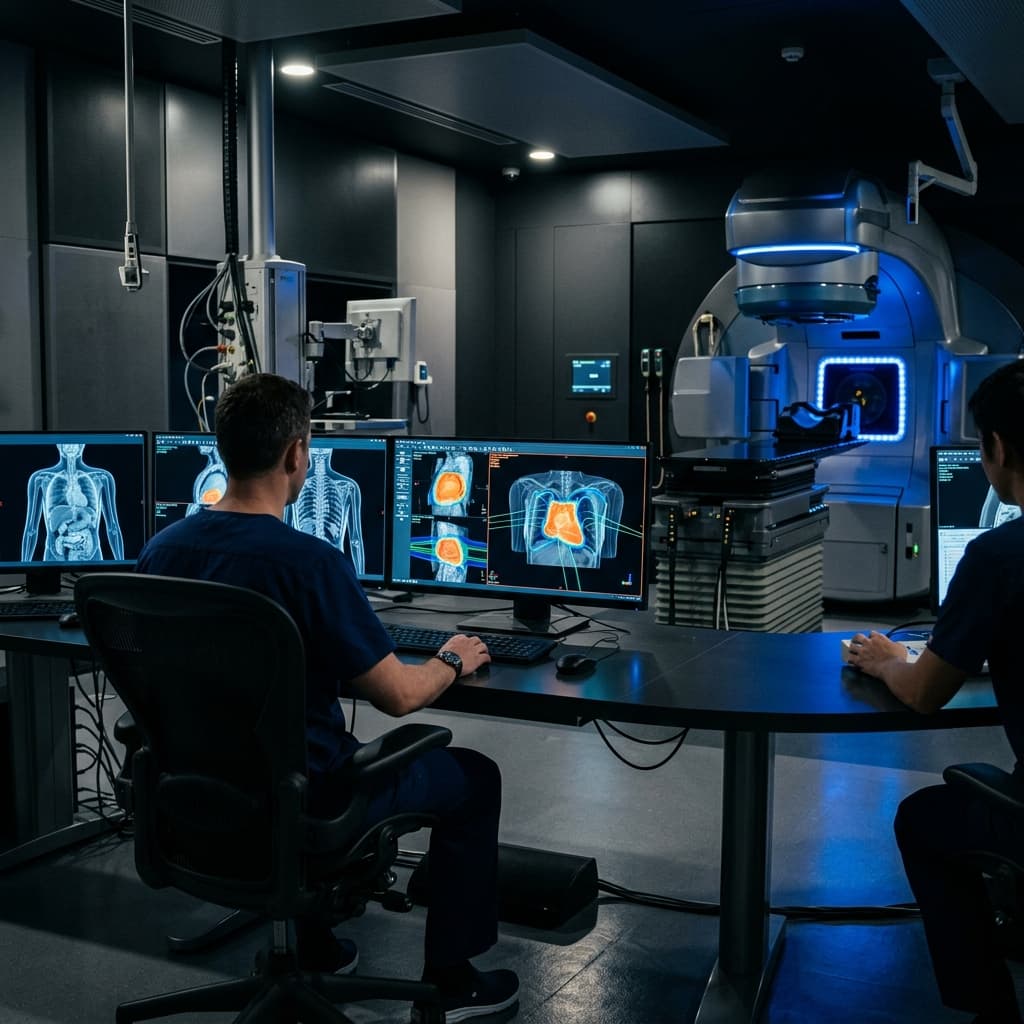
Planning a radiotherapy treatment for breast cancer is no trivial task. An experienced medical physicist can spend hours — sometimes days — defining doses, angles, and irradiation fields that maximize tumor targeting while minimizing damage to the heart and lungs. Now, researchers at the University of California San Diego (UCSD) have published results showing that deep learning methods can significantly compress this process without sacrificing — and in some cases improving — the quality of the therapeutic plan.
For those working in healthtech, medtech, or medical imaging software in Brazil, this is not just another piece of news about hospital AI. It is a signal that the technology is moving away from generic use cases — summarizing documents, replying to emails, organizing data — toward the acceleration of specific clinical workflows with measurable operational value.
What the UCSD researchers developed
The UCSD team's work focuses on using deep neural networks to automate and optimize critical steps in radiotherapy planning. The traditional process involves the manual segmentation of anatomical structures (the tumor, the heart, the lungs), followed by iterative dose calculation by medical physicists — a cycle that can require multiple rounds of revision and medical approval.
The proposed deep learning approach targets precisely this bottleneck: training models on large databases of validated historical treatment plans so that the system learns to propose treatment configurations with high precision. The model does not replace the medical physicist or the oncologist; it delivers a starting point so well calibrated that the number of adjustment iterations drops drastically.
The reported results indicate gains in both speed — reduction in planning time — and dosimetric quality, measured by standardized indices in the field such as the Dose Volume Histogram (DVH). In some cases, the automatically generated plans outperformed the benchmarks of manual plans on organ-at-risk protection metrics.
Why breast cancer is an ideal test case
Breast cancer accounts for approximately 30% of all cancer diagnoses in women in Brazil, according to data from the Instituto Nacional de Câncer (INCA). Radiotherapy is indicated in most cases following conservative surgery, making breast radiotherapy planning one of the most frequent procedures at oncology centers.
At the same time, it is anatomically complex. The proximity of the tumor to the heart — especially in left-sided tumors — demands millimetric precision to avoid late cardiac toxicity. This tension between efficacy and safety is exactly the kind of multivariable problem in which deep neural networks, trained on thousands of cases, can outperform manual estimation.
Comparing with what already exists
AI-assisted planning solutions already exist on the market. Varian Medical Systems (now part of Siemens Healthineers) offers RapidPlan, a knowledge-based planning tool that uses statistical models to suggest plans. Elekta, a direct competitor, has similar tools integrated into the Monaco Treatment Planning System.
What sets the UCSD approach apart is not necessarily the premise — which is similar — but the use of more modern deep learning architectures, such as 3D convolutional networks and attention models, which are capable of capturing complex spatial dependencies that traditional statistical models miss. A direct performance comparison with RapidPlan still requires multicenter validation, but the preliminary results are solid enough to warrant the industry's attention.
What this means for a healthtech or medtech business
If you develop or distribute software for radiotherapy clinics in Brazil, there are immediate practical implications.
First, the medical physicist bottleneck is real. Brazil has a chronic shortage of medical physicists qualified in radiotherapy. Automating the generation of the initial plan — even if the professional still validates and adjusts it — can increase patient throughput without increasing headcount. At public centers such as the Hospital de Câncer de Barretos or the INCA, where the waiting list for radiotherapy can stretch to weeks, this has a direct impact on lives.
Second, this opens up space for clinical software-as-a-service (SaaS) models. A healthtech SME that integrates a deep learning-assisted planning module — trained on Brazilian data, with local anatomies and protocols — can offer this as a service to smaller clinics that lack the scale to hire in-house expertise.
Third, the regulatory barrier exists but is navigable. In Brazil, ANVISA requires registration of Software as a Medical Device (SaMD) for solutions that influence diagnosis or treatment. The process has costs and timelines — but companies that begin this journey now will get ahead of a market that is still taking shape.
What to watch over the next 12 months
The UCSD research is still in the clinical validation phase. The natural next step is a prospective multicenter study, with a head-to-head comparison between AI plans and manual plans in terms of real outcomes — not just dosimetric metrics. If these results hold up, the pressure on TPS (Treatment Planning System) vendors to incorporate native deep learning will be inevitable.
For the Brazilian ecosystem, the practical lesson is this: specific clinical AI, trained on real workflows, already demonstrates measurable operational value — and the radiotherapy segment is one of the most ready to absorb this change. Those who wait for a finished, imported product will pay more and have less competitive advantage than those who start building now.

Thinking Machines Lab launches Inkling: 975 billion open-weight parameters
Mira Murati's Thinking Machines Lab launches Inkling, an open-weight MoE model with 975 billion parameters. What changes for Brazilian companies?

Kimi K3: the largest open-weight model ever released has 2.8T parameters
Moonshot released Kimi K3: 2.8 trillion parameters and a 1-million-token context window. What actually changes, and what open-weight really delivers.
Meta Brain2Qwerty v2: when the mind becomes a keyboard with 61% accuracy
Meta decodes brain activity into text with 61% accuracy — no surgery required. What this changes for business, healthcare, and accessibility.