AI in Retail: 98% Accuracy in Loss Prevention and Proven ROI
NVIDIA's AI systems reach 98% accuracy in retail loss prevention. Here is what that means for small and mid-sized businesses.
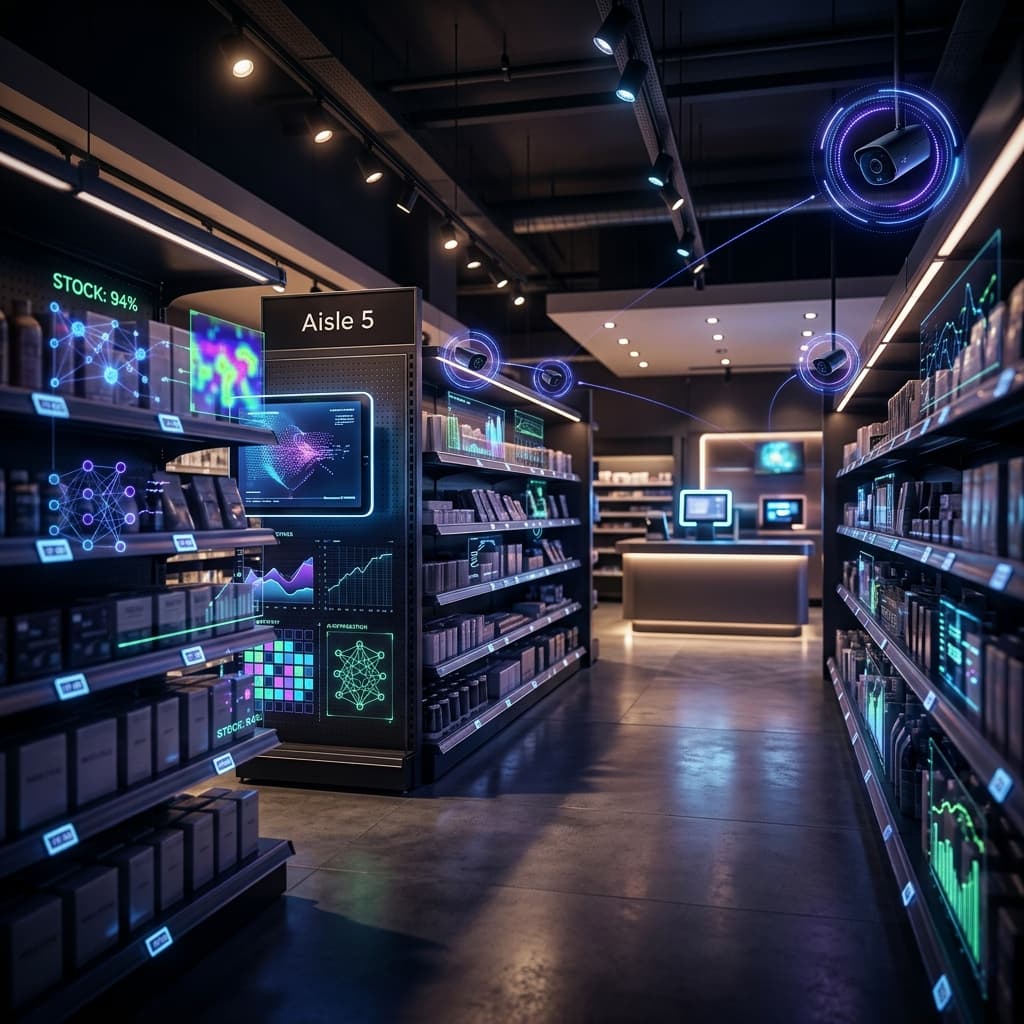
The Number That Changes the Argument
For years, retail managers in Brazil treated loss prevention technology as a fixed cost: cameras, security guards, manual audits, with no real expectation of measurable return. That reasoning is becoming obsolete fast. AI systems developed by NVIDIA for the retail sector are recording 98% accuracy in detecting theft, fraud, and operational errors. This is not a lab promise. It is documented performance in real operations.
For an SMB decision-maker, whether running a regional pharmacy chain, an independent supermarket, or a mid-sized department store, that number deserves careful attention. Because it changes the nature of the debate: we are no longer discussing whether AI works. We are discussing when and how to implement it.
The Real Problem of Retail Loss in Brazil
Brazil loses approximately R$ 26 billion per year to retail shrinkage, according to data from the Brazilian Association of Loss Prevention (ABRAPPE). Some of that is external theft. But a significant share comes from operational error, internal diversion, and checkout fraud, precisely the blind spots that traditional systems cannot cover consistently.
The old model has structural limitations. A human security guard covers one area at a time. An auditor analyzes a sample, not the full universe of transactions. A camera records, but does not alert in real time. AI reverses that logic: it monitors everything, all the time, without fatigue and with increasing accuracy.
What 98% Accuracy Means in Practice
When a system reaches 98% accuracy, what does that represent operationally? It means that out of every 100 real incidents (a product passed under the conveyor belt, a swapped label, a fraudulent return) the system identifies 98 with enough precision to trigger an alert or record evidence. The false-positive rate drops dramatically, which reduces unnecessary interruptions and protects the customer experience.
For an SMB operating on tight margins, every percentage point of loss reduction directly impacts the operating result. A store with R$ 5 million in annual revenue losing 2.5% to shrinkage that recovers half of that adds R$ 62,500 to the bottom line, without increasing a single sale.
Adoption Has Reached an Inflection Point
According to recent industry research, 35% of retail companies are already actively using AI, and another 42% are evaluating use cases. That means that within the next 6 to 12 months, most competitive retailers will have some layer of artificial intelligence operating in their structure.
The risk of inaction is becoming greater than the risk of acting. When your competitors operate with 40% lower loss costs because AI is detecting deviations in real time, the competitive disadvantage accumulates quietly, month after month, on the income statement.
In my experience working with SMBs in Brazil, Italy, and the United States, the biggest barrier to adoption is not technological. It is the belief that these solutions are exclusive to large chains. That myth is being dismantled by the data. Cloud-based platforms, subscription models, and integrations with existing POS systems have made access economically viable for mid-sized operations.
Where to Start: A Pragmatic Reading
For an SMB manager considering this path, I recommend three questions before any investment:
First: where are your largest sources of loss today? External theft, operational error, and internal diversion each call for different solutions. An honest diagnosis directs the right investment.
Second: is your current infrastructure (cameras, POS, ERP) compatible with AI integration? In many cases, already-installed hardware can be reused with the addition of computer vision software.
Third: what is your acceptable payback cycle? Most AI implementations for loss prevention show payback between 8 and 18 months. That varies depending on operation volume and current loss rate.
The Retailer That Does Not Digitize Loses Twice
There is a cruel irony in retail that resists technology: it pays twice. First, for the losses it cannot detect. Second, for the operational inefficiency of manual processes that could be automated. AI-driven loss prevention solves the first problem and frequently generates data that helps solve the second.
The message I bring to the CEOs and managers I work with is straightforward: 98% accuracy with proven ROI is no longer a technical argument. It is a business argument. And in Brazilian retail in 2025, ignoring that argument is a choice with very concrete financial consequences.
The technology has reached the point where the burden of proof has shifted. AI no longer needs to prove it works. It is up to the manager to explain why they are not using it yet.

Thinking Machines Lab launches Inkling: 975 billion open-weight parameters
Mira Murati's Thinking Machines Lab launches Inkling, an open-weight MoE model with 975 billion parameters. What changes for Brazilian companies?

Kimi K3: the largest open-weight model ever released has 2.8T parameters
Moonshot released Kimi K3: 2.8 trillion parameters and a 1-million-token context window. What actually changes, and what open-weight really delivers.
Meta Brain2Qwerty v2: when the mind becomes a keyboard with 61% accuracy
Meta decodes brain activity into text with 61% accuracy — no surgery required. What this changes for business, healthcare, and accessibility.