NVIDIA Ising: Open-source AI to accelerate quantum computing
NVIDIA released the Ising family, open-source AI models that address errors and calibration in quantum processors. What it means for companies.
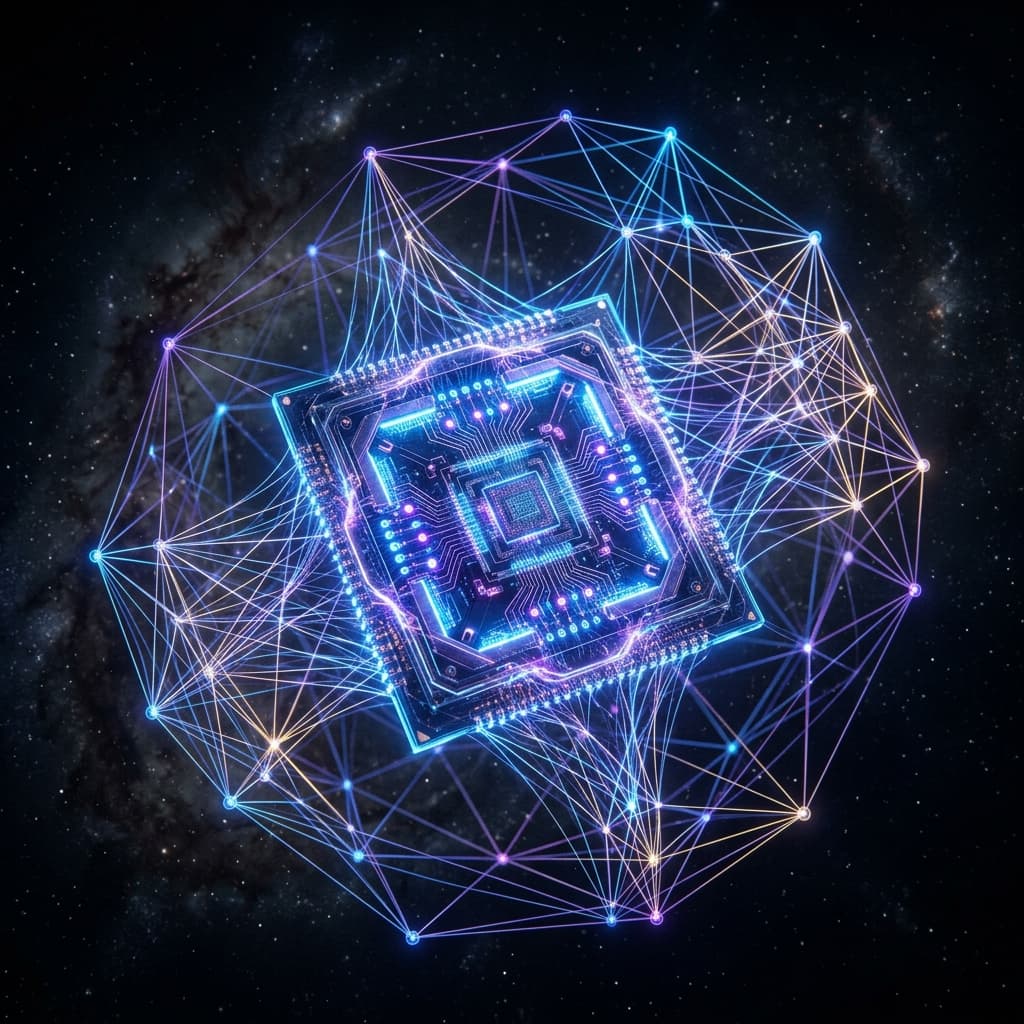
Quantum computing has always lived under the shadow of a huge promise and a frustrating reality: quantum processors make many errors, are hard to calibrate, and scale poorly. NVIDIA decided to address exactly these two bottlenecks with a clear bet, the Ising family, a set of open-source AI models developed specifically for error correction and calibration of quantum processors.
The name is no coincidence. The Ising model is a classic of statistical physics, used for decades to describe magnetic spin systems, and it has become one of the favorite mathematical frameworks for formulating combinatorial optimization problems. NVIDIA took that reference and turned it into a family of models trained to deal with the noise inherent to qubits and with the complexity of keeping a quantum processor operating within reliable parameters.
What Is Ising and how it works in practice
The Ising family is not a single monolithic model. It is a collection of open models that operate on two distinct, yet interdependent fronts within a quantum system:
Quantum error correction: Qubits are extremely sensitive to environmental disturbances, such as temperature fluctuations, electromagnetic fields, and vibrations. This produces error rates that, today, still make it infeasible to run complex quantum algorithms without a robust layer of correction. Ising models are trained to identify error patterns and suggest corrections at a speed that purely algorithmic approaches cannot match.
Processor calibration: Keeping a quantum processor calibrated is a continuous and intensive task. Small variations in the control parameters of each qubit can degrade operation fidelity within hours. Ising applies AI to automate and accelerate this calibration process, reducing dependence on specialized engineers monitoring systems around the clock.
The fact that the family is open-source matters for a concrete reason: research teams, deep tech startups, and corporate labs can integrate, adapt, and contribute to the models without proprietary licensing. This speeds up the experimentation cycle, something the quantum ecosystem still needs badly.
Why this matters now
The Ising launch does not happen in a vacuum. It arrives at a moment when the quantum race is becoming less theoretical: IBM has its Quantum Development roadmap, Google Quantum AI has reported progress on error correction, and companies like IonQ and Quantinuum are attracting capital at an increasing pace. NVIDIA, historically a GPU company, has been systematically building a position in the quantum ecosystem, with CUDA Quantum as the most visible proof.
Ising is the next step in that strategy: not to manufacture quantum processors, but to become the indispensable software and AI layer for those who operate them. It is the same playbook that worked in the generative AI market: control the software stack while third-party hardware proliferates.
For technical and innovation teams in Brazil, this has an immediate practical meaning: the tools to experiment with quantum computing are becoming more accessible and less prone to operational failures. Universities, research institutes such as INPE and LNCC, and companies in finance, energy, and logistics that are already watching quantum potential for portfolio optimization, routing, and process optimization gain an additional layer of reliable infrastructure to start real experiments.
What changes for a business
The question every technology manager should be asking is not "when will quantum computing be ready?", but rather "what needs to change so I am ready when it arrives?"
Ising partially answers that question. By addressing error correction and calibration with AI, NVIDIA is essentially compressing the time between the current state of quantum processors, noisy and unstable, and the state required to run commercially useful algorithms. That interval, which experts estimated at 5 to 10 years just a few years ago, is beginning to shrink.
What innovation teams should do now
Not everything should be a full bet on quantum. But there are three concrete moves that make sense now:
- Map optimization use cases within the business that today rely on heuristics because the search space is too large for classical computers, such as scheduling, resource allocation, molecule design, and complex pricing.
- Monitor NVIDIA's CUDA Quantum ecosystem, which now includes Ising. Familiarizing the technical team with this stack costs little and can be decisive when quantum processors reach sufficient fidelity for these use cases.
- Treat quantum as an R&D line, not as a digital transformation project. The horizon is still uncertain, but knowledge assets (team, problem modeling, partnerships) are built now.
The frontier that is moving
Ising is a signal. Not that quantum computing has arrived, but that the distance between the laboratory and application is measurably decreasing. When a company of NVIDIA's scale deploys open-source AI resources to solve the most fundamental problems of quantum hardware, it is betting that this market will scale, and that it wants to be at its center when that happens.
For those who build technology strategy in Brazil, ignoring this movement is a risk that quietly grows. The cost of attention is low. The cost of arriving late, historically, is not.

Thinking Machines Lab launches Inkling: 975 billion open-weight parameters
Mira Murati's Thinking Machines Lab launches Inkling, an open-weight MoE model with 975 billion parameters. What changes for Brazilian companies?
Kimi K3: the largest open-weight model ever released has 2.8T parameters
Moonshot released Kimi K3: 2.8 trillion parameters and a 1-million-token context window. What actually changes, and what open-weight really delivers.
Meta Brain2Qwerty v2: when the mind becomes a keyboard with 61% accuracy
Meta decodes brain activity into text with 61% accuracy — no surgery required. What this changes for business, healthcare, and accessibility.