SmolVLA: affordable humanoid robots for SMEs on commodity hardware
Hugging Face released SmolVLA, an open-source 450M-parameter model that enables autonomous robotics for SMEs without heavy infrastructure.
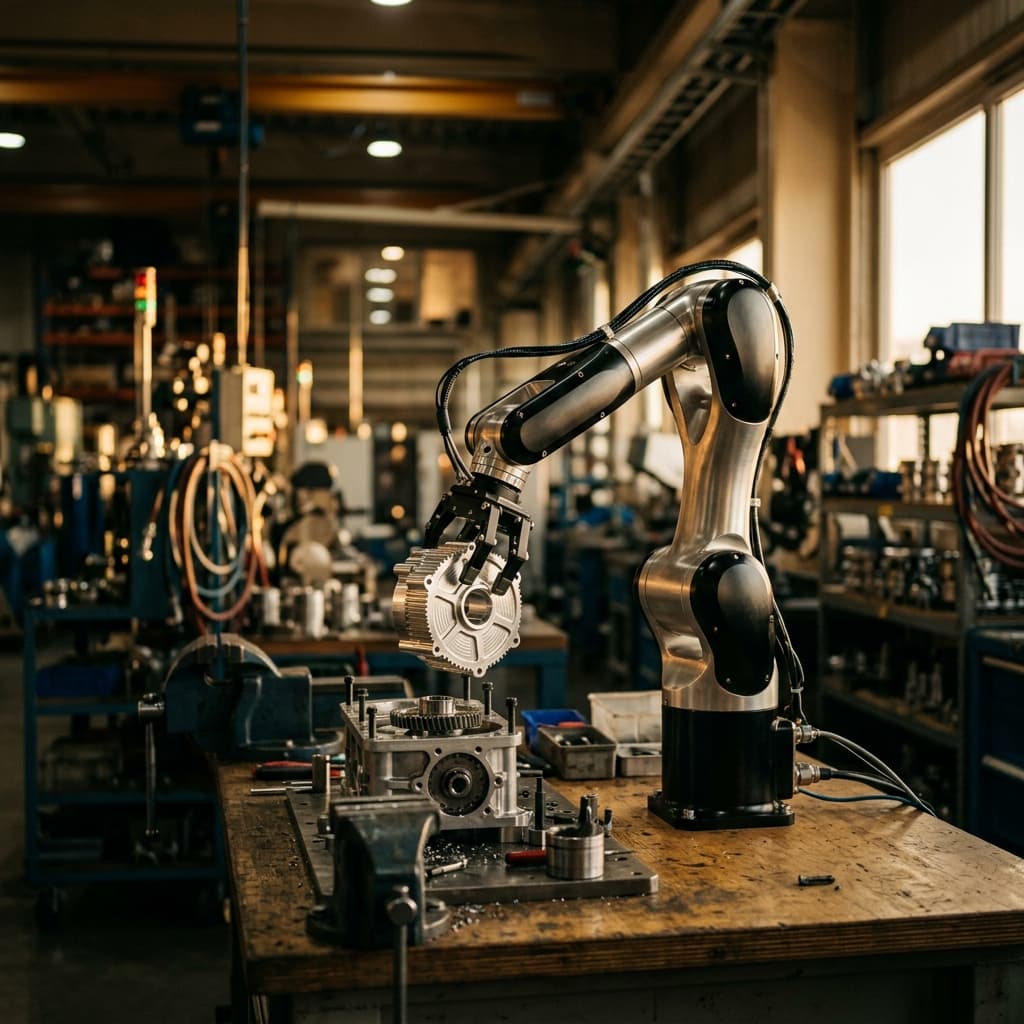
In June 2025, Hugging Face released something few expected so soon: a Vision-Language-Action model, the SmolVLA, with just 450 million parameters, fully open-source, capable of running on consumer hardware and delivering performance comparable to much larger models. For those who follow the industrial and automation sector, this is not just a technical curiosity. It is a step change for SMEs that until now have been outside autonomous robotics.
O que é o SmolVLA e por que o tamanho importa
VLA, Vision-Language-Action, is a class of models that connects computer vision, natural language understanding and the generation of physical actions in robots. In practice: the robot sees the environment, understands an instruction in human language and executes a sequence of movements. The concept is not new. What is new is doing this with 450 million parameters.
For comparison: earlier reference VLA models, such as Google DeepMind's RT-2, operate around 55 billion parameters. That requires data center GPUs, expensive cloud infrastructure and dedicated ML teams, barriers absolutely incompatible with the reality of a medium-sized company in Minas Gerais, an agricultural cooperative in Paraná, or a component factory in the interior of São Paulo.
The SmolVLA changes that equation. With 450M parameters, it can run on a consumer GPU, such as an NVIDIA RTX 4090, which costs around R$ 10 to 12 thousand in the domestic market, and still execute manipulation tasks with competitive success rates on standardized benchmarks used by the open robotics community.
Como funciona na prática
The SmolVLA architecture combines a lightweight visual encoder with a compact language model (derived from Hugging Face's own SmolLM family) and an action policy module that translates intentions into motor commands. Training used the LeRobot dataset, a set of robotic demonstration data also maintained by Hugging Face.
The model is provided with pretrained weights and open-source code in the organization's official repository. That means a small internal technical team can perform fine-tuning for specific tasks without starting from scratch. The imitation learning cycle is accessible: film an operator performing the task, generate demonstration data, and adjust the model to replicate that behavior on the robot (imitation learning).
Hardware compatível e custo real
SmolVLA was validated on the LeRobot SO-100, an open-source robotic arm whose parts kit can be assembled for about USD 100 to 150 , roughly R$ 600 to 900 at the current exchange rate. Added to an entry-level GPU already present in many companies, the prototyping cost of a functional robotic cell becomes counted in thousands of reais, not in hundreds of thousands.
This is the number that changes the conversation.
O que isso representa para PMEs brasileiras
I have worked with Brazilian SMEs for years and I hear the same response when the topic is robotics, "It's too expensive, it's too complex, it's for large companies." That argument was correct until very recently. Now, it begins to lose traction.
Consider concrete, immediate use cases:
- Agroindustry: picking and sorting products on processing lines, where visual variability and manual dexterity are required, precisely the domain where VLAs excel.
- Light manufacturing: kit assembly, language-guided visual inspection, palletizing small volumes.
- Internal logistics: moving items in compact warehouses, using natural language instructions instead of rigid trajectory programming.
In all these scenarios, what prevented adoption was the need to integrate with expensive proprietary systems, cloud LLMs with latency and per-call cost, and specialized hardware. SmolVLA compresses those three barriers at once.
O que ainda é limitação real
It would be dishonest not to point out the limits. Smaller models sacrifice generalization: SmolVLA performs well on tasks for which it has been trained or fine-tuned, but it lacks the zero-shot robustness of larger models when facing completely new situations. In addition, the ecosystem of low-cost humanoid robots is still forming, and integrating the model with existing industrial platforms requires real engineering effort.
That said, for SMEs the strategy does not need broad generalization. It needs focus: identify one or two repetitive tasks with high labor cost, build a small high-quality demonstration dataset and perform targeted fine-tuning. That cycle is now achievable with an SME budget and team.
O que fazer agora
The window of competitive advantage for early experimenters is real, and it will not last forever. My practical recommendation for SME leaders:
- Map your repetitive manual tasks that incur the highest cost or scale bottleneck.
- Evaluate the LeRobot SO-100 as a prototyping platform, the initial investment is low enough to be treated as operational R&D.
- Build a small clean dataset of demonstrations for the target task before thinking about the model.
- Involve your technical team , an engineer with Python and ML experience can operationalize SmolVLA using the resources available in the public repository.
Hugging Face did not invent accessible robotics in one move. But SmolVLA removes a technical and financial barrier that was, until now, the main argument for not starting. That argument is over.

Thinking Machines Lab launches Inkling: 975 billion open-weight parameters
Mira Murati's Thinking Machines Lab launches Inkling, an open-weight MoE model with 975 billion parameters. What changes for Brazilian companies?

Kimi K3: the largest open-weight model ever released has 2.8T parameters
Moonshot released Kimi K3: 2.8 trillion parameters and a 1-million-token context window. What actually changes, and what open-weight really delivers.

Meta Brain2Qwerty v2: when the mind becomes a keyboard with 61% accuracy
Meta decodes brain activity into text with 61% accuracy — no surgery required. What this changes for business, healthcare, and accessibility.