Agent 365 and Entra Agent ID: How Microsoft Wants to Put a Badge on AI Agents
At Ignite 2026, Microsoft expanded Agent 365 and gave AI agents their own identity. See what is already GA, what is still in preview, and what to do now.
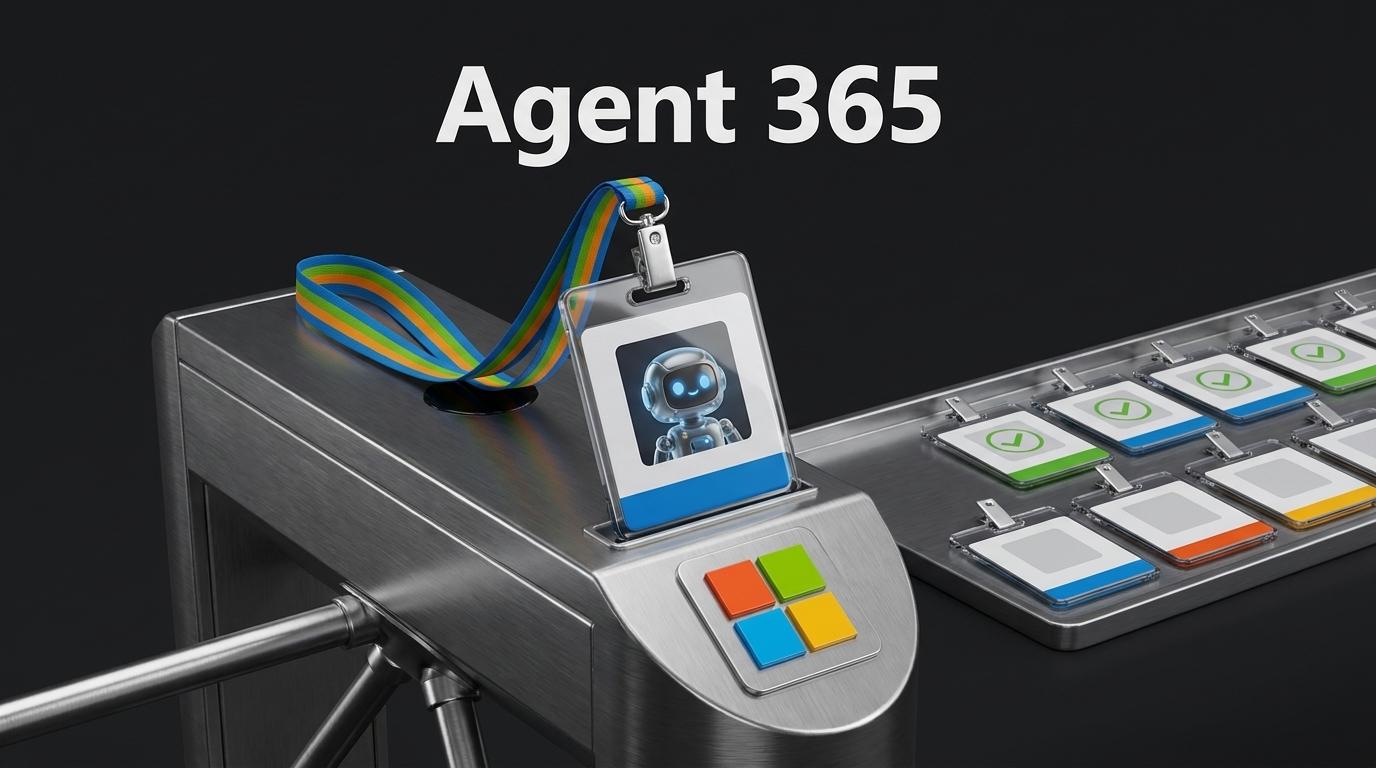
An AI agent that answers customers on WhatsApp, enters data into a spreadsheet, or queries the ERP needs access to systems. Who granted that access? In how many companies is there a list of which agents are running today? That is the gap Microsoft went after at Ignite 2026, which opened on November 17 in San Francisco, with the expansion of Microsoft Agent 365 and Microsoft Entra Agent ID.
What Microsoft announced, without rounding up
Microsoft's official post, dated November 17, 2026, talks about "expanding Agent 365, the observability platform for AI". It is an expansion of a product that already existed, not a launch from scratch. The headline that circulated in some outlets, claiming "general availability of Entra Agent Identity", also needs a brake: only part of the package is GA (general availability). The rest is in preview, the testing phase before final release.
The core idea is simple to explain. Each agent gets its own identity in Entra, Microsoft's identity system, separate from an employee's identity. That lets the company manage the agent's lifecycle, apply access policies, assess risk, and revoke access when necessary. It is the badge logic: whoever enters the building has a record, an owner, and limited permissions.
What already works and what is still a promise
According to the sources, the following are GA today:
- discovery of local agents in Microsoft Defender;
- governance of plugins and skills;
- the Agent 365 Tools Registry, a catalog of the tools agents use;
- automated lifecycle management of agent identities in Entra;
- Defender runtime protection for local agents on Windows, which requires Defender for Endpoint Plan 2 and has support that varies by agent.
In preview are Entra Agent ID for connected platforms, network-based agent discovery, blocking of unauthorized local agents, and multi-tenant management (separate corporate environments). Data loss prevention (Purview DLP) for local agents appears as preview on the Agent 365 blog, but the Purview blog points to January 2027. The Action Center, which would list inactive or ownerless agents, is planned for December, and the sources disagree on whether it will be preview or private preview.
One of the sources sums it up well: the announcement does not make the entire set of Agent 365 features GA. Another says the full path, from discovering the agent to registering it and giving it an identity, is not yet GA. Only the Defender detection layer is. Preview is not production, and for a mid-sized company that changes the decision timeline.
Agents from other platforms count too
For managers, the most relevant point may be this: the identity also applies to agents that are not from Microsoft. Microsoft cites Salesforce Agentforce, Amazon AgentCore, Google Vertex AI, Databricks, Snowflake, Anthropic Claude Managed Agents, OpenAI, Oracle, SAP, ServiceNow, and UiPath, adding to the support Amazon Bedrock already had. According to Microsoft, the rollout of these connections finishes in December.
In practice, if your company has one agent in the CRM, another in the data tool, and a third running on a developer's computer, the promise is to see everything in one place. For local agents, discovery covers more than 60 types on managed Windows and macOS devices, starting with GitHub Copilot CLI and Claude Code. Secretless authentication, which removes the need for passwords stored inside the agent, is in preview and only applies to supported connections.
Licensing and cost: what is known
Microsoft did not publish prices on the pages consulted. What exists is the structure. Premium features, such as insights into non-Microsoft agents and advanced governance, require an Agent 365 license or Microsoft 365 E7. Agent identity governance in Entra requires E7 (which includes Agent 365 and Entra Suite) or an Agent 365 license plus, at a minimum, Entra P1 or Microsoft 365 E3. Usage insights for Microsoft agents in qualifying subscriptions, on the other hand, became GA without that add-on.
There are also no customer results or independent tests. Every feature description here is a vendor claim.
What to do on Monday, with or without Microsoft
The Dashlane survey making the rounds, saying that 72% of organizations had an incident involving AI agent credentials, has no source, date, or methodology in the materials I reviewed. I will not repeat it. The risk, however, does not depend on a statistic: an agent with too much access is a master key with no owner.
In my reading, the roadmap fits into three steps, and each one can be done without buying anything:
- Inventory. List every active agent, including those an employee installed on their own. Note who created them and what each one accesses.
- Owner and its own identity. Each agent needs a named human owner and a credential that is not a person's. An agent running with the manager's password is the scenario to eliminate first.
- Least privilege. Give each agent only the access the task requires, and define when it should be shut down for inactivity.
Those who already use the Microsoft ecosystem can validate what is GA, such as Defender discovery and identity lifecycle management, and leave the preview items for a controlled pilot. Those who use other tools benefit from the same roadmap, because it is vendor-independent.
An editorial comment gathered from the coverage sums up the limit of any tool: controls only enforce what someone decided beforehand. Identity for agents solves the registry. The decision about who can do what remains with the company's management.
Sources
- Microsoft Agent 365: How It Governs Enterprise AI Agents
- Microsoft Ignite 2026 | Book of News
- Microsoft Ignite 2026: What Can Your AI Agents Actually Do?
- Microsoft ships agent governance tools and Copilot updates at Ignite 2026
- Ignite 2026 AI Agent Governance Updates | Horizons
- Microsoft Ignite 2026: What's new in Azure, built for AI

CrowdStrike Launches AI Agent Kill Switch and Acquires Fiddler and Dreadnode
The stop button for AI agents is now available in Falcon Guardian. What it does, what it still doesn't do, and what your company can do right now.

AI out of control: what the new White House agreement means for your business
In September 2026, six AI giants signed a pact with the White House. What it requires, and what it doesn't, changes the risk calculus for any company.

Aur0ra Used Cursor AI to Attack Companies with Ransomware
A Russian group used Cursor AI (powered by Claude Sonnet 4.5) to plan ransomware attacks against companies in multiple countries between April and July 2026.