Claude Sonnet 5: top-tier agentic AI at a price that fits an SMB
Anthropic released Claude Sonnet 5 with performance close to Opus 4.8 at a fraction of the cost. Here is what changes for automation and AI in your day-to-day.

Anthropic has just released Claude Sonnet 5, and the headline that matters for anyone running a business is simple: a model with near-top-tier performance, at a fraction of the price. What only a few months ago required large, expensive models now fits an SMB's budget.
If you follow this from a distance, here is the jargon-free summary — and, above all, what it changes in practice for customer service, automation and everyday work.
What Claude Sonnet 5 is
Sonnet 5 is the new version of Anthropic's "mid" line — the same family that made AI useful for coding and automation (Sonnet 3.5, 3.6 and 3.7 were the first to show real skill at those tasks).
The news is that it was built to be the most "agentic" Sonnet yet. In plain terms: beyond answering questions, it can make a plan, use tools (like a browser and a terminal) and carry out multi-step tasks on its own — without a human nudging it at every step.
According to Anthropic, Sonnet 5's performance gets close to Claude Opus 4.8 (the company's most capable model), but at a much lower price. Compared to its predecessor, Sonnet 4.6, it's a clear leap in reasoning, tool use, coding and knowledge work.
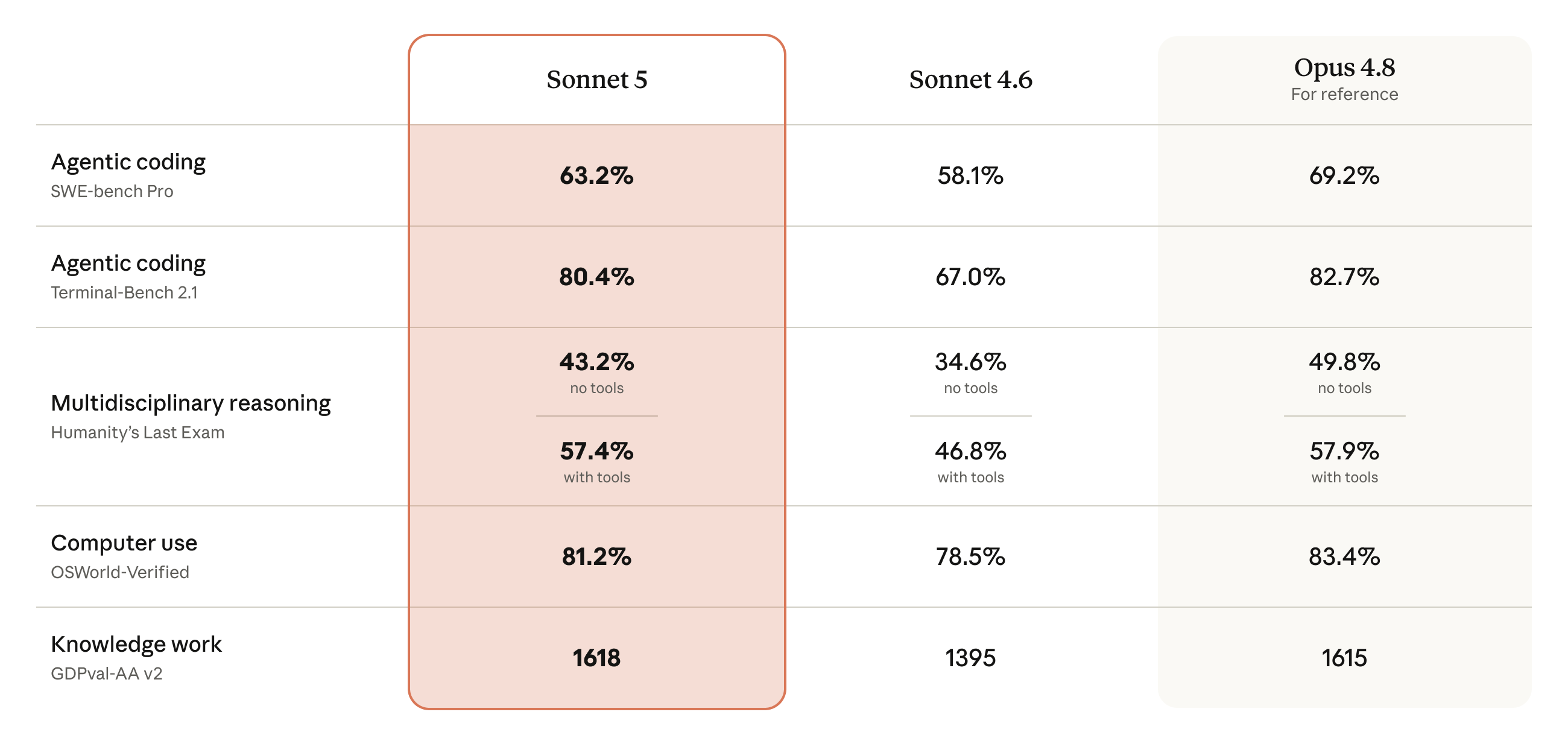
"More agentic" — what that means for your business
"Agentic" has become a buzzword, but the concept is concrete: it's the difference between an AI that suggests what to do and an AI that does it and checks the result.
The partners who tested Sonnet 5 before launch described exactly that: the model finishes complex tasks where previous versions would stop halfway, and checks its own work without being told to. One of them shared a real case: they asked it to "update account tiers in Salesforce and send a launch announcement to enterprise contacts" — and it did both, end to end. That kind of task used to stall halfway.
For a company, that's what separates a "pretty demo" from automation that actually takes repetitive work off the team: sales follow-up, order triage, system updates, first response in support. Work that follows a script, but requires seeing it through.
Price: top-tier power for less
Here's the point that changes the game for small and medium businesses. At launch, Sonnet 5 arrives with an introductory price of US$2 per million input tokens and US$10 per million output tokens, valid through August 31, 2026. After that, it moves to US$3 (input) and US$15 (output) per million tokens.
For comparison, Opus 4.8 — the most capable model — costs US$5 and US$25 per million tokens. In other words: Sonnet 5 delivers much of the top model's capability at roughly a third to half the cost.
It's already the default model on the Free and Pro plans, available on Max, Team and Enterprise, in Claude Code and on the developer platform (via the API, with the identifier claude-sonnet-5).
You choose how much "effort" to pay for
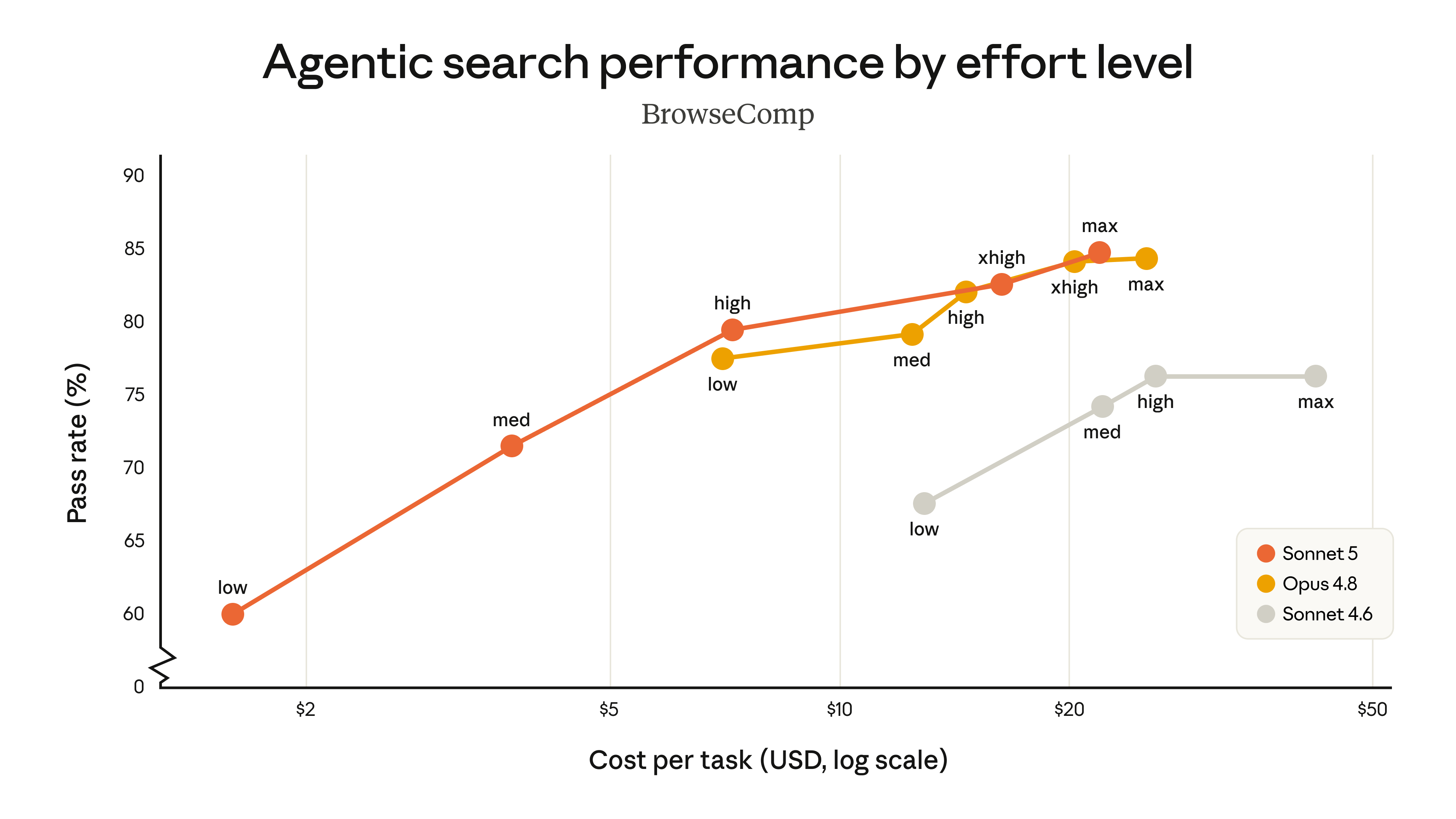
A practical new detail: Sonnet 5 works with adjustable effort levels. On simpler tasks you use less effort (cheaper and faster); on hard tasks you raise the effort and performance climbs — in some cases matching Opus 4.8.
In practice, it's a "cost vs. quality" dial your operation controls. For routine automation, low effort solves it cheaply. For a more delicate analysis, you turn the level up only for that task.
Safety: better aligned, with active safeguards
On the safety side — a topic we take seriously here at FM — Anthropic reports that Sonnet 5 showed an overall lower rate of undesirable behaviors than Sonnet 4.6, plus less hallucination and less sycophancy (the tendency of an AI to agree with you at any cost). It also refuses malicious requests more firmly and resists prompt-injection attacks better.
An important point for anyone thinking about risk: Sonnet 5 launched with cybersecurity safeguards enabled by default, and has much lower capability than the Opus models for potentially dangerous cyber tasks (like developing exploits). In one specific evaluation, it could not build a working exploit. Translation: a strong model for business work, with a safety brake against misuse.
What it changes for your company
Sonnet 5's central message isn't technical, it's economic: professional-grade AI automation just got cheaper. The kind of agent that executes tasks end to end — not just answers — is no longer a privilege of whoever pays for the priciest model.
For an SMB, that opens three immediate fronts:
- Customer service and sales: assistants that qualify leads, reply on WhatsApp and book meetings, at a cost per conversation that finally makes the math work.
- Process automation: multi-step tasks (update a system, generate a report, send an announcement) that used to need a person to "push" them to the finish line.
- Knowledge work: research, analysis and document drafts with more reliability and less review.
The technology became accessible. What separates those who get results from those who only test is the implementation: pick the right task, connect the model to the systems you already use, and measure the return — without becoming a hostage to an endless "AI project."
Next step
If you want to understand where agentic AI actually pays off in your operation — and not just where it looks good on a slide — that's exactly our job at FM Solutions: map the manual task that costs the most, automate it with AI, and deliver it working.
Get a free assessment and we'll show you, based on your reality, the first process worth automating right now.

Thinking Machines Lab launches Inkling: 975 billion open-weight parameters
Mira Murati's Thinking Machines Lab launches Inkling, an open-weight MoE model with 975 billion parameters. What changes for Brazilian companies?

Kimi K3: the largest open-weight model ever released has 2.8T parameters
Moonshot released Kimi K3: 2.8 trillion parameters and a 1-million-token context window. What actually changes, and what open-weight really delivers.
Meta Brain2Qwerty v2: when the mind becomes a keyboard with 61% accuracy
Meta decodes brain activity into text with 61% accuracy — no surgery required. What this changes for business, healthcare, and accessibility.