GPT-6.2 Sol: $2 per Million Tokens and What It Changes in Your Operating Costs
OpenAI launched GPT-6.2 Sol at $2/$10 per million tokens. See where it fits in a midsize company's routine and how to test it without risk.
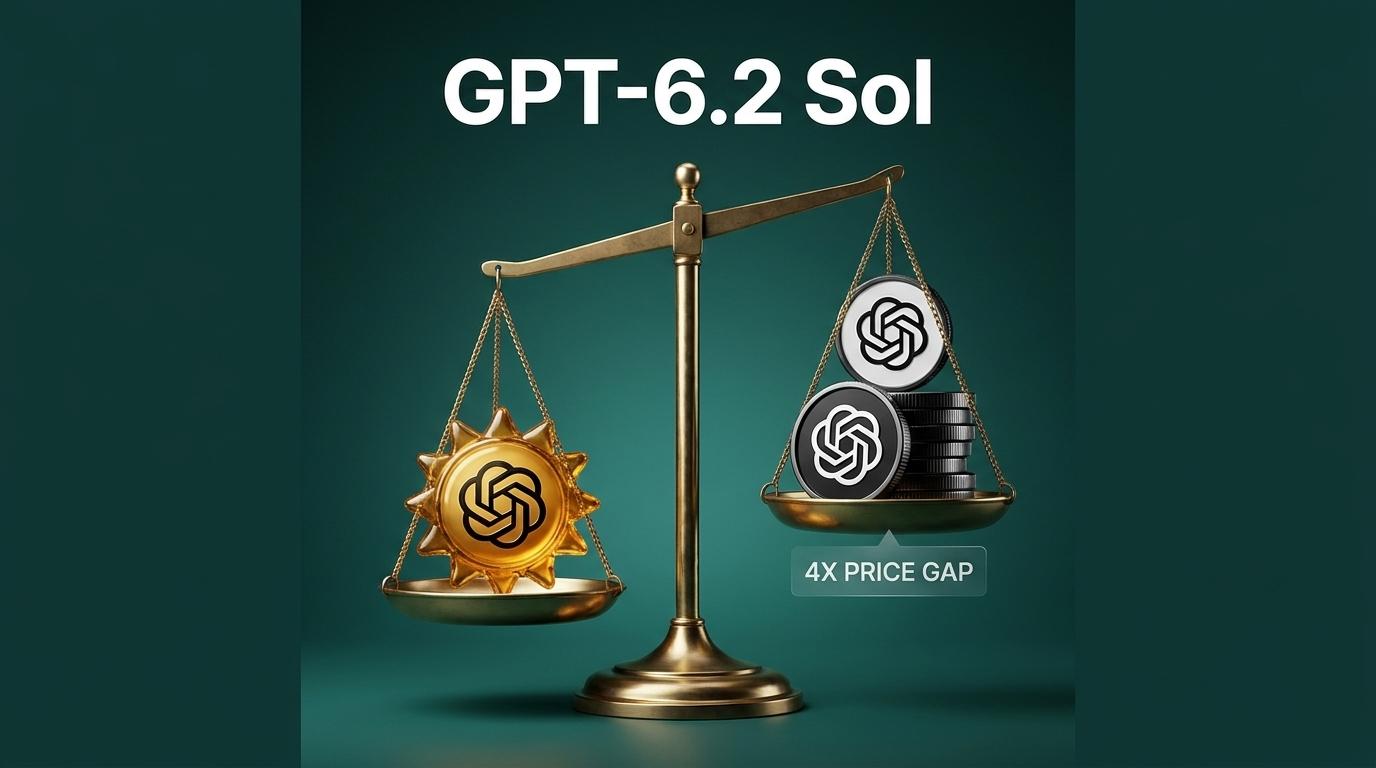
On November 17, 2026, OpenAI launched two models at once: GPT-6.2 Astra and GPT-6.2 Sol. Sol costs $2.00 per million input tokens and $10.00 per million output tokens, the same price as the GPT-6.1 Sol it replaces. A token is the chunk of text the AI reads and writes, and it's what you pay for. For anyone running a midsize company, the math that matters is a different one: how much does each task your team no longer does by hand actually cost?
Two models, two kinds of work
OpenAI split its lineup by difficulty level. Astra is the flagship, aimed at demanding programming, research, professional deliverables, and agents that work for long stretches. It costs $8 per million input tokens and $40 per million output tokens. According to financefeeds.com, citing The Decoder, that represents a 20% cut in API pricing compared to GPT-6 Astra.
Sol sits on the floor below. OpenAI itself describes it as the model for everyday work, "from coding to powering agents at scale." In other words: repetitive, high-volume routines are its home turf.
The price gap is big. Astra costs four times as much as Sol, on both input and output.
What Sol delivers in practice
According to the official specs, Sol reads text and images and responds in text. Audio and video are not supported. The context window is 1,050,000 tokens, which lets you hand the model a large volume of material at once: long contracts, support history, manuals. The response can run up to 128,000 tokens.
It also uses tools. In OpenAI's Responses API, there is web search and computer use, and parts of the work can be delegated to subagents (a feature still in beta).
Think about three common tasks in a midsize company:
- Customer support: read the customer's WhatsApp message, check the history, and draft a reply for an agent to approve.
- Finance: check an invoice against a purchase order and flag discrepancies before anyone opens the spreadsheet.
- Sales: turn a quote request received by email into a draft proposal.
These are volume tasks, where cost per unit weighs more than the model's sophistication. Sol was designed for this profile.
What independent measurements say
None of the numbers below is an official OpenAI measurement. Artificial Analysis, an independent evaluator, measures Sol with an intelligence index that varies by the configured effort level: 41 at the lowest, 52 at medium, 55 at high, 56 at xhigh, and 57 at maximum. It places Sol among the leading models in intelligence, with "moderately priced" pricing.
Higher effort comes at a cost in time. A task takes an average of 1.7 minutes at the low level and 10.1 minutes at maximum. For quick customer replies, the low or medium level (3.6 minutes) tends to make more sense. For analysis nobody needs right away, the high level is worth it. The same source measured an average cost of $1.47 per task across all effort levels.
Venice's table, dated November 25, 2026, shows Sol scoring 96.5% on GPQA Diamond, a test of graduate-level questions. In the same table: Gemini 4 Hydrogen at 94.9%, Kimi K3.1 Pro at 91.9%, Claude Sonnet 5.5 at 90.4%, and Claude Sonnet 5 at 85.9%. The source doesn't explain where that figure comes from, so treat it as a reference, not a verdict. A direct comparison between Sol and Astra was not published in the material I reviewed.
Where costs can climb
The $2/$10 price applies to standard use and short context. Some situations make it more expensive:
- Long context: on AWS, the higher rate applies when input exceeds 272,000 tokens. On Cloudflare, it is $3.00 for input and $15.00 for output.
- Ultrafast mode: costs 3 times the standard rate through February 28, 2027, and 6 times starting March 1, 2027.
- AWS cloud: on Bedrock, regional options come in at $2.20 and $11.00; the global option is $2.00 and $10.00.
Anyone running the numbers should look at the typical size of the material the model reads, not just the list price.
Precautions before going to production
UOL reported, on launch day, new code security restrictions and more safeguards on the models. The details don't appear in the excerpts I was able to verify. I also didn't find, in the verified material, the system's classification under OpenAI's safety framework, and the claim that Astra uses a smaller fraction of tokens per task appears only in generic form: according to the company, both models deliver better results on demanding tasks with fewer tokens. Before deciding based on that, it's worth reading OpenAI's official material.
How to start without betting the budget
My recommendation, based on what I see in companies of this size, follows four steps:
- Pick a single pain point. For example, the triage of quote requests that eats up hours of the sales team's time every week.
- Run Sol on it for a few weeks, with human review. Someone on the team approves every output before it reaches the customer or the system.
- Measure cost per task and rework. If the team corrects half the responses, the problem is in the process or the instructions, and switching models won't fix it.
- Only then test Astra on the hard cases. The fourfold price difference only pays off where Sol fails.
This is my own logic, not a conclusion from the sources: using the cheaper model for volume and reserving the pricier one for complex work tends to lower the cost per task. The only supporting data is the price difference between the two.
Where it's already available
As of November 26, 2026, Sol is live. It appears in ChatGPT Work and Codex for the Plus, Pro, Enterprise, and Edu plans (for the last two, it depends on activation by the administrator) and in the API as gpt-6.2-sol. It is also on AWS Bedrock, Cloudflare, OpenRouter, Venice, and Kilo Code. On Google Cloud, it remains in private preview.
For a midsize company, this means you don't need a large-scale contract to test it. You can start with one task, measure the result, and only then decide the size of the investment. The cost of the project depends on the case, and FM Solutions only gives numbers after looking at the operation.
Sources
MAI Code 2: Microsoft's coding model that promises results at 5% of the price
Microsoft says MAI Code 2 delivers 96% of Claude Opus 5.5's coding performance at about 5% of the price. The numbers are its own. Here is what to test before migrating.

Claude Fable 5.2 lands at No. 1 on an independent ranking, priced 20% lower
Fable 5.2 tops an independent ranking, costs $8 per million input tokens, and calls for testing on your real cases before any switch.

GPT-6.1 Terra: AI That Uses the Computer at Half the Price
OpenAI launched GPT-6.1 Terra on 10/26/2026: it reads the screen, fills out forms, and costs $1 per million input tokens. What changes for small and midsize businesses.