AMD Acquires World Labs for $8.2B and Enters the Physical AI Era
AMD acquires Fei-Fei Li's startup for $8.2 billion and bets on AI that understands and simulates the physical world. What this changes for businesses.
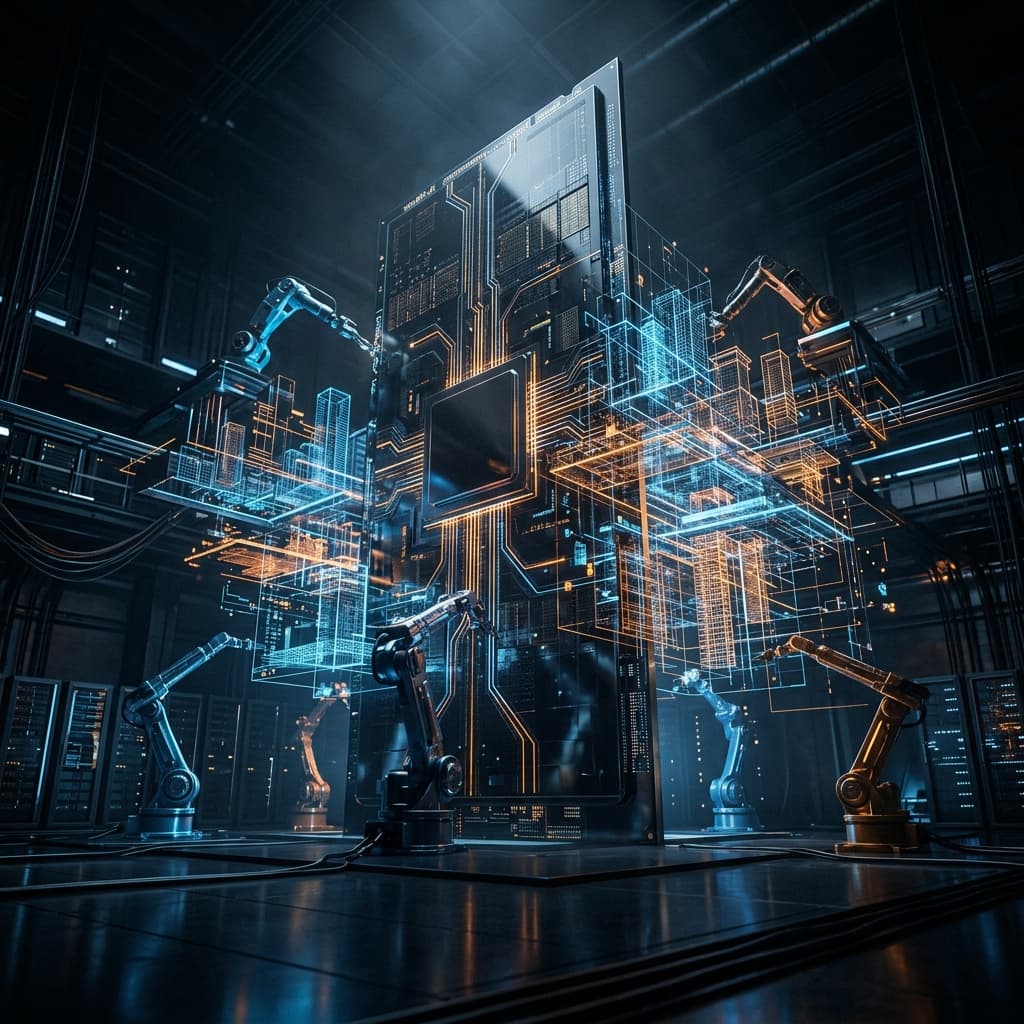
On September 28, 2026, AMD and World Labs jointly announced an all-stock acquisition worth $8.2 billion, with no cash outlay. The California-based startup, founded by Stanford researcher and professor Fei-Fei Li, is roughly two years old and offers a proposition that goes beyond what large language models deliver: teaching machines to understand the physical world, with depth, motion, and real interactions.
The deal is still subject to regulatory approvals and is expected to close by the end of 2026. Until then, both companies will operate independently.
What World Labs Is and Why It's Worth $8.2 Billion
World Labs works with what the industry calls "world models": artificial intelligence systems trained to simulate and generate three-dimensional environments. These systems learn how objects move, how they interact with each other, and how physical space behaves. Training uses video data, not text.
The practical difference is enormous. A language model predicts the next word. A world model predicts what happens when a robot pushes a box on a conveyor belt, when an autonomous car brakes on a wet curve, or when a mechanical arm tries to fit a part into a specific position. This capability is what the industry has dubbed "physical AI" or "spatial intelligence."
The startup raised $1 billion in 2026 at a valuation of $5 billion, according to Infobae, a source that attributes the figure to the context of that funding round and one that was not corroborated by other sources consulted. AMD participated in that same round. The $8.2 billion acquisition represents a significant premium over that valuation and is, according to the portal Olhar Digital, the largest M&A deal tied to AI in AMD's history, and the second largest in the company's overall history, behind only the acquisition of Xilinx, completed in 2022 for approximately $50 billion.
What Changes in Practice: AMD vs. Nvidia on New Terrain
Before this deal, AMD was competing in the AI processor market against Nvidia by concentrating its efforts on text and video models. Nvidia, for its part, already offered Cosmos, a family of open-source world models geared toward physical simulation. AMD entered that confrontation with a clear gap in this segment.
World Labs closes that gap. The company has publicly demonstrated a model called Marble, capable of generating a three-dimensional scene from just a few images. The demonstration was conducted by Fei-Fei Li and AMD CEO Lisa Su.
Su stated in the announcement: "Together, we will combine World Labs' deep expertise in AI and world models with AMD's computational leadership to drive the future of AI and strengthen the open AI ecosystem."
The move positions AMD directly in the markets for robotics, autonomous vehicles, industrial simulation, and virtual training environments. These are markets where the ability to simulate the physical world with precision is no longer a differentiator, it is a prerequisite.
Why This Matters for Business Operators in Brazil
It may seem like an $8.2 billion transaction between two American companies has nothing to do with the operations of a distributor in São Paulo, a manufacturer in the interior of Minas Gerais, or a retail chain in the South. But the chain of consequences is direct.
The world models that World Labs develops are the technological foundation that will power the next generation of automation. Robots that learn to perform tasks in simulated environments before operating on the real factory floor. Visual inspection systems that understand depth and motion, not just pixels. Design and architecture tools that generate and test three-dimensional structures without the cost of physical prototyping.
Fei-Fei Li, when commenting on the technology, put it this way: intelligent agents, whether robots, vehicles, or tools, can learn inside rich digital worlds that are aware of the laws of physics before they ever need to be placed in the real world, making them far safer.
This has a direct implication for cost and risk. A company that adopts robotics today needs months of calibration in the real environment, with costly errors. With precise physical simulation, a significant portion of that learning happens before the equipment ever reaches the warehouse floor.
The timeline for this type of solution to reach mid-sized companies in Brazil is not a matter of weeks. But the speed at which the infrastructure is being built, and the level of capital being allocated, indicates that timeline is compressing.
The Data Point That Sets the Pace
There is a technical bottleneck accelerating all of this: there is a shortage of real training data for general-purpose robots. Specialized industrial robots have decades of data. Generalist robots, which need to handle varied environments, do not. The approach the industry is adopting is to generate synthetic data, that is, data produced through simulation rather than collected in the real world. World models like those from World Labs are the central tool for doing this.
Whoever controls this simulation layer will dictate the pace at which the best generalist robots can be trained. That is why AMD paid a premium over the startup's last valuation round, and why Fei-Fei Li will take on the role of Executive Vice President and Chief Scientist at AMD, reporting directly to CEO Lisa Su.
What to Watch in the Coming Months
The deal closes by the end of 2026, provided regulatory approvals come through on schedule. Until then, World Labs and AMD continue to operate separately. No World Labs product is commercially available at the time of the announcement. The Marble model was publicly demonstrated, but without a release date, price, or access conditions disclosed.
For those following the technology and automation sector in Brazil, the most relevant signal is structural. The race for AI chips has stopped being solely about which GPU trains a language model fastest. It now includes who can simulate the physical world with enough fidelity to train the next generation of autonomous machines. That is AMD's $8.2 billion bet.
Sources
- www.business-standard.com › world-news › amd-toAMD to acquire Fei-Fei Li's World Labs in $8.2 billion bet on ...
- AMD acquires Fei-Fei Li's physical AI startup World Labs ...
- AMD to buy Fei-Fei Li's World Labs in $8.2 billion bet on ' ...
- AMD acquiring Fei-Fei Li's World Labs AI firm in deal worth ...
- AMD compra 'inteligência espacial' de 'madrinha da IA' por US$ 8,2 bilhões
- AMD anuncia aquisição de empresa de inteligência artificial de pesquisadora por R$ 44,3 bilhões
GPT-6 Astra: OpenAI declares the 'AGI era' and reinvents enterprise agents
Released on September 3, 2026, GPT-6 Astra is OpenAI's largest training run and the first model classified as "Critical" in cybersecurity.
OpenAI Jalapeño: the chip challenging Nvidia in inference efficiency
OpenAI releases Jalapeño benchmarks: its in-house chip delivers up to 1.9x more work per watt and 3.6x lower latency than Nvidia's Blackwell.
Thomson 1.0: Thomson Reuters' Own Legal-Tax LLM
Thomson Reuters launches its first proprietary LLM with US$ 40M invested. What changes for law firms, legal departments, and tax practices?